Prepare and rebuild to a verified boundary
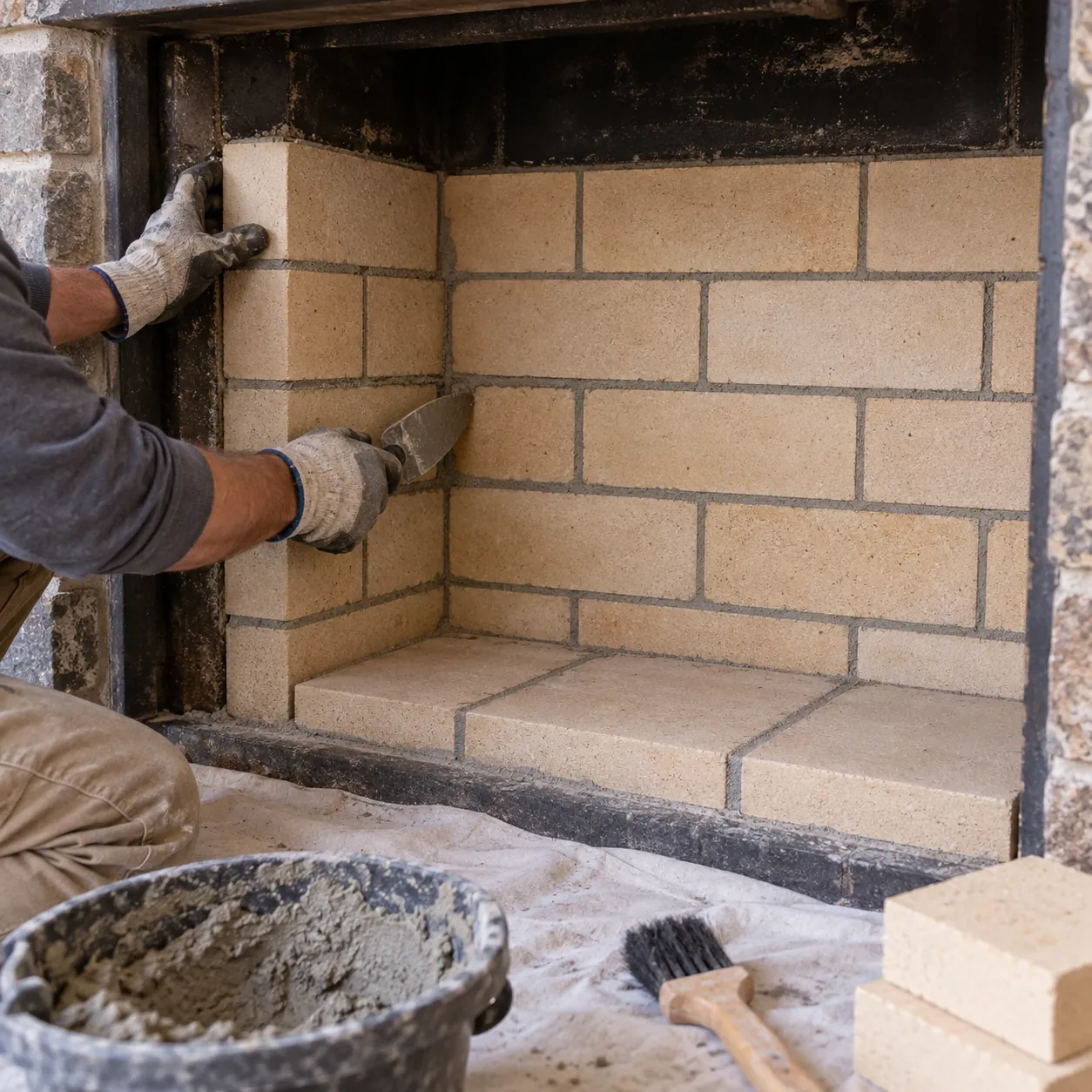
Identify the exact component, remove failed heat-exposed material to a stable boundary, use compatible refractory products where required and keep the venting system within specialist scope.
North Texas masonry service
Fireplace and firebox masonry work must distinguish decorative facing from heat-exposed firebrick, refractory mortar, the smoke chamber and the venting system.
Direct answer
Fireplace and firebox masonry work must distinguish decorative facing from heat-exposed firebrick, refractory mortar, the smoke chamber and the venting system.
Ordinary face brick and mortar are not automatically suitable inside a firebox. Cracked firebrick, open joints or a shifted lintel can expose adjacent materials to heat. Cosmetic facing repair can be masonry work; questions about draft, liner, appliance performance or combustion require an appropriate fireplace professional.
For North Texas properties, the same visible defect can come from different combinations of exposure, construction type, openings, prior work and building movement. A useful estimate therefore names the repair endpoint, the assumptions behind it and the conditions that would change the scope. It does not treat a city name, a photograph or a material label as a complete diagnosis.
Send one whole-wall view, one context view showing grade or openings, and one close detail. Include the city or ZIP and what changed.
How to photograph the condition ↗Correct vs. incomplete
A repair is complete only when preparation, material, sequence and the likely cause agree with one another.
Identify the exact component, remove failed heat-exposed material to a stable boundary, use compatible refractory products where required and keep the venting system within specialist scope.
Fill firebox gaps with ordinary caulk or general-purpose mortar, cover cracked units with a thin coating, or relight the fireplace before safety-related conditions are reviewed.
Is it the right fit?
Scope layer by layer
Separate hearth, surround, firebox, damper, smoke chamber, flue and exterior chimney.
Use materials rated and compatible for the temperature and location.
Review lintel, firebrick alignment and gaps before a surface repair.
Do not represent masonry work as a complete flue, draft or appliance inspection.
How to read the work
Before work begins, the affected area should be distinguishable from neighboring sound material. During removal, the installer should be able to explain what confirms that the prepared edge is stable. New brick, stone or mortar should be selected for compatibility as well as appearance. Where water reaches the assembly, the scope should identify how it will drain or dry after the visible work is complete.
Afterward, review joint fullness, alignment, protection of adjacent surfaces and the transition from new work to old. Fresh masonry can change color as it cures, so the evaluation should follow the agreed sample and realistic weathering expectations rather than an instant promise of invisibility.
Request a project review
A photo-first review helps identify the relevant service page and the questions that belong in an on-site visit. It does not replace inspection where movement, hidden support, elevated work or active moisture controls the scope.
Typical process
Photograph the complete feature, the condition in context and a close detail with scale.
Review safety, access, water, movement, support and material compatibility before selecting the repair.
Write the repair boundary, preparation, materials, appearance expectations, exclusions and change conditions.
Protect adjacent work, perform the agreed sequence, manage curing and keep the site orderly.
Walk the finished boundary, cleanup, drainage details and any monitoring or maintenance recommendations.
Estimate factors
Photos can support an initial range, but final cost depends on measured quantity, access and what the prepared area reveals. A low unit price is not useful if the assumed boundary excludes the condition that made the repair necessary.
North Texas context
Dallas–Fort Worth climate normals include hot summers, recurring heavy-rain events and winter freezes. Regional maps also identify shrink–swell soils across parts of North Texas. Those conditions explain why movement and moisture deserve attention, but the cause at one address must be supported by the actual wall, grade, drainage, openings and history.
When the repair depends on structural capacity, parcel-level soil behavior, roofing, a fireplace system or municipal approval, the written scope should identify the qualified specialist or authority that must answer that question.
Keep exploring
Chimneys receive concentrated weather exposure at the crown, shoulders, joints and flashing.
Open page ↗Visible conditionLoose or Broken BricksLoose units and impact damage need a stable repair boundary and a compatible replacement.
Open page ↗Visible conditionCrumbling Mortar JointsSoft, recessed or missing mortar can admit water and reduce the wall’s weather protection.
Open page ↗Keep exploring
Read the exposed top, masonry joints and roof intersection as one system.
Open page ↗SafetyDIY Brick & Mortar Repair LimitsWhere small maintenance ends and diagnostic, access or structural risk begins.
Open page ↗MaterialsBrick & Mortar Matching GuideColor is only one part of a believable and compatible masonry match.
Open page ↗Keep exploring
Local context, related symptoms and official permit information for Prosper.
Open page ↗Dallas / Denton / Collin CountyFireplaces & Fireboxes questions in CarrolltonLocal context, related symptoms and official permit information for Carrollton.
Open page ↗Tarrant CountyFireplaces & Fireboxes questions in North Richland HillsLocal context, related symptoms and official permit information for North Richland Hills.
Open page ↗Dallas CountyFireplaces & Fireboxes questions in DeSotoLocal context, related symptoms and official permit information for DeSoto.
Open page ↗Dallas / Ellis CountyFireplaces & Fireboxes questions in Cedar HillLocal context, related symptoms and official permit information for Cedar Hill.
Open page ↗Common questions
Heat-exposed areas commonly require compatible refractory materials; the existing construction and product instructions must be checked.
Appearance alone cannot establish safety. Stop use if the condition is uncertain and obtain an appropriate inspection.
Yes when the issue is limited to decorative masonry and the firebox and venting system are confirmed separately.
Use a qualified chimney or fireplace professional for liner, draft and combustion-safety questions.
Start with the project
Send a few details and useful photos for an initial review.