Confirm the system and likely driver
Compare movement, moisture, support, openings, previous repair and the sound boundary. Escalate structural, roofing or safety questions when they are outside masonry scope.
Visible masonry symptom
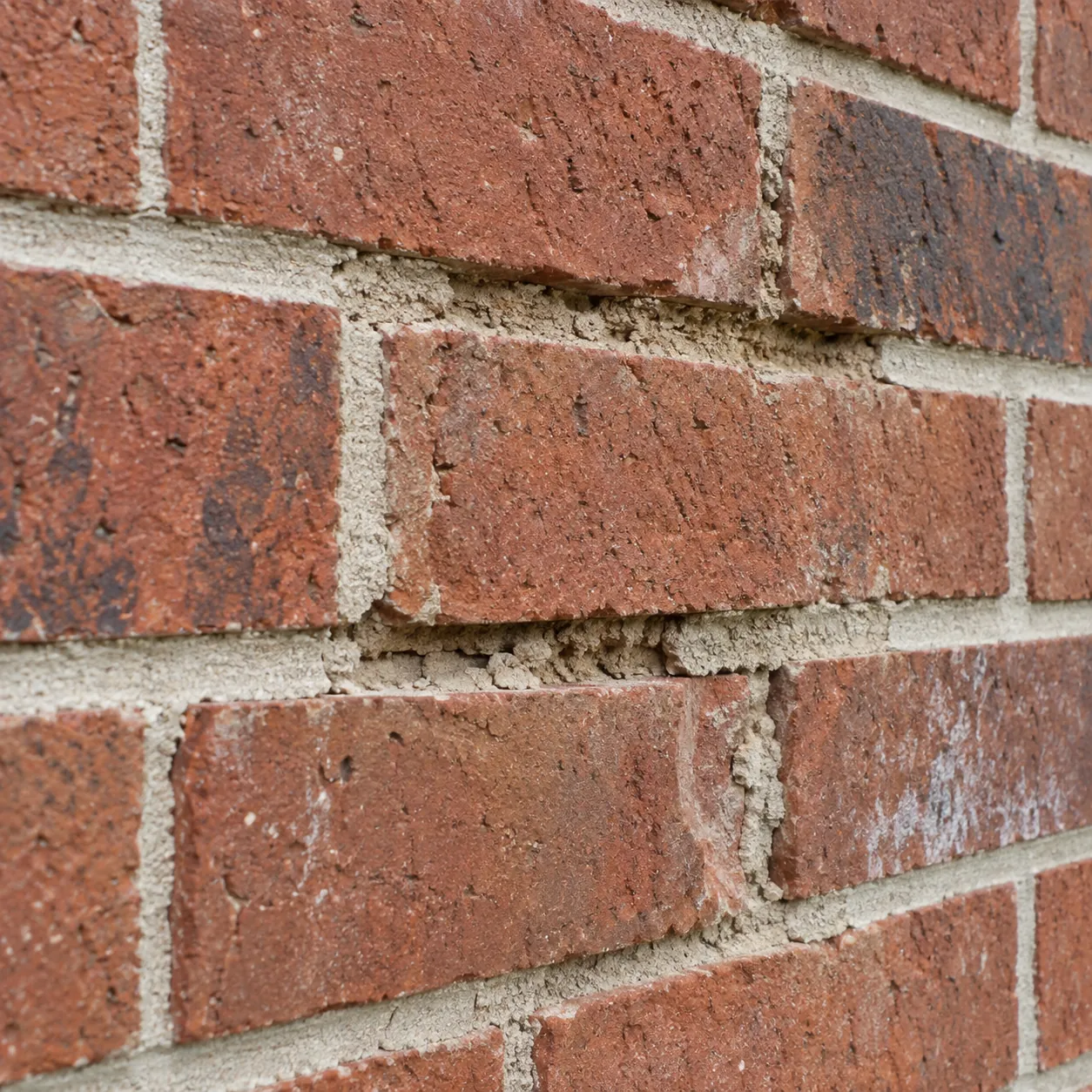
Crumbling mortar means the joint has lost material or cohesion. The cause may be weathering, water, incompatible repair, poor curing or movement; sound preparation determines whether repointing will last.
Quick answer
Crumbling mortar means the joint has lost material or cohesion. The cause may be weathering, water, incompatible repair, poor curing or movement; sound preparation determines whether repointing will last.
Soft, recessed or missing mortar can admit water and reduce the wall’s weather protection. Several causes can create a similar face pattern, which is why the first job is to preserve evidence and separate urgent safety questions from the eventual repair method.
Photographs can establish location, extent and visible movement. They cannot confirm concealed ties, corrosion, framing, flashing or soil behavior. When those details control the decision, an on-site review or a qualified specialist must come before cosmetic work.
Before → evaluate → repair
This is an educational decision path, not a claimed customer before-and-after project.
Compare movement, moisture, support, openings, previous repair and the sound boundary. Escalate structural, roofing or safety questions when they are outside masonry scope.
Deteriorated joints removed to sound material and renewed with a compatible mortar and joint profile. The scope should explain preparation, compatible materials, exclusions and what would require a change.
Correct vs. incomplete
A thin face smear bonds to the weakest material and can fall away while the deep joint remains empty.
The responsible direction is to decide whether the condition is stable, what system is involved and which repair endpoint is supported by the evidence. A clean appearance is a result; it is not the diagnostic method.
See the related Mortar Repair & Repointing service ↗Possible causes
These are investigation paths, not a remote conclusion about the property.
Mortar can erode gradually as the sacrificial part of the wall.
Caps, flashing, sprinklers or grade can keep a band of joints damp.
A dense patch can redirect stress and moisture into softer neighboring mortar or brick.
Too much water, poor compaction or rapid drying can leave a friable surface.
Opening and closing can break otherwise serviceable mortar.
How to document it
Do not climb, pull on loose work or remove material merely to obtain a photo.
Compare sheltered, exposed, high and low joints rather than testing one spot.
Show recessed joints beside intact units and use a safe size reference.
Record where staining or softness aligns with caps, sills, sprinklers and grade.
Different color and hardness can reveal where earlier work changes the pattern.
Problem → question → next step
Request a condition review
Include the city or ZIP, when the condition was first noticed and whether it changed after rain, heat, a freeze, impact or nearby construction. That helps separate a masonry repair inquiry from a structural, roofing or safety question.
Urgency
Keep people and vehicles away from loose units, pronounced bulges, leaning freestanding walls and damaged masonry above doors or walks. Do not stabilize elevated work with improvised bracing. Rapid change, significant displacement, an uncertain load path or widespread distress can justify structural review before masonry repair.
Other specialists
A roofer may need to correct flashing; a chimney professional may need to inspect liner or draft; an engineer may need to evaluate support or movement; a municipality or historic-review office may control the approved scope. The masonry proposal should say where its responsibility begins and ends.
Keep exploring
White deposits indicate moisture transported soluble salts through masonry; the water path matters.
Open page ↗ProblemSpalling BricksA lost brick face is a symptom often connected to moisture, salts, freeze events or incompatible repair.
Open page ↗ProblemChimney Brick & Mortar DamageChimneys receive concentrated weather exposure at the crown, shoulders, joints and flashing.
Open page ↗Keep exploring
Weather, water, movement, material compatibility and previous repair.
Open page ↗Mortar jointsRepointing vs. TuckpointingThe practical difference between joint repair and a decorative historic technique.
Open page ↗MaterialsMortar Caulk vs. Real MortarWhat flexible sealant can do, what mortar does and why they are not interchangeable.
Open page ↗Keep exploring
Local service, related symptoms and official permit information for Celina, Texas.
Open page ↗Tarrant CountyCrumbling Mortar Joints questions in KellerLocal service, related symptoms and official permit information for Keller, Texas.
Open page ↗Dallas / Kaufman CountyCrumbling Mortar Joints questions in MesquiteLocal service, related symptoms and official permit information for Mesquite, Texas.
Open page ↗Tarrant / Johnson / Ellis CountyCrumbling Mortar Joints questions in MansfieldLocal service, related symptoms and official permit information for Mansfield, Texas.
Open page ↗Tarrant CountyCrumbling Mortar Joints questions in EulessLocal service, related symptoms and official permit information for Euless, Texas.
Open page ↗Common questions
Preparation, depth, brick-edge protection, mix compatibility and curing all matter; a shallow refill is not equivalent to repointing.
Splashback, irrigation, grade and slower drying can increase exposure near the base.
Not necessarily. Incompatible stiffness or low permeability can transfer damage into brick or adjacent joints.
Samples can create a believable match, but aggregate, tooling and weathering affect the result as much as pigment.
Start with the project
Send a few details and useful photos for an initial review.