Confirm the system and likely driver
Compare movement, moisture, support, openings, previous repair and the sound boundary. Escalate structural, roofing or safety questions when they are outside masonry scope.
Visible masonry symptom
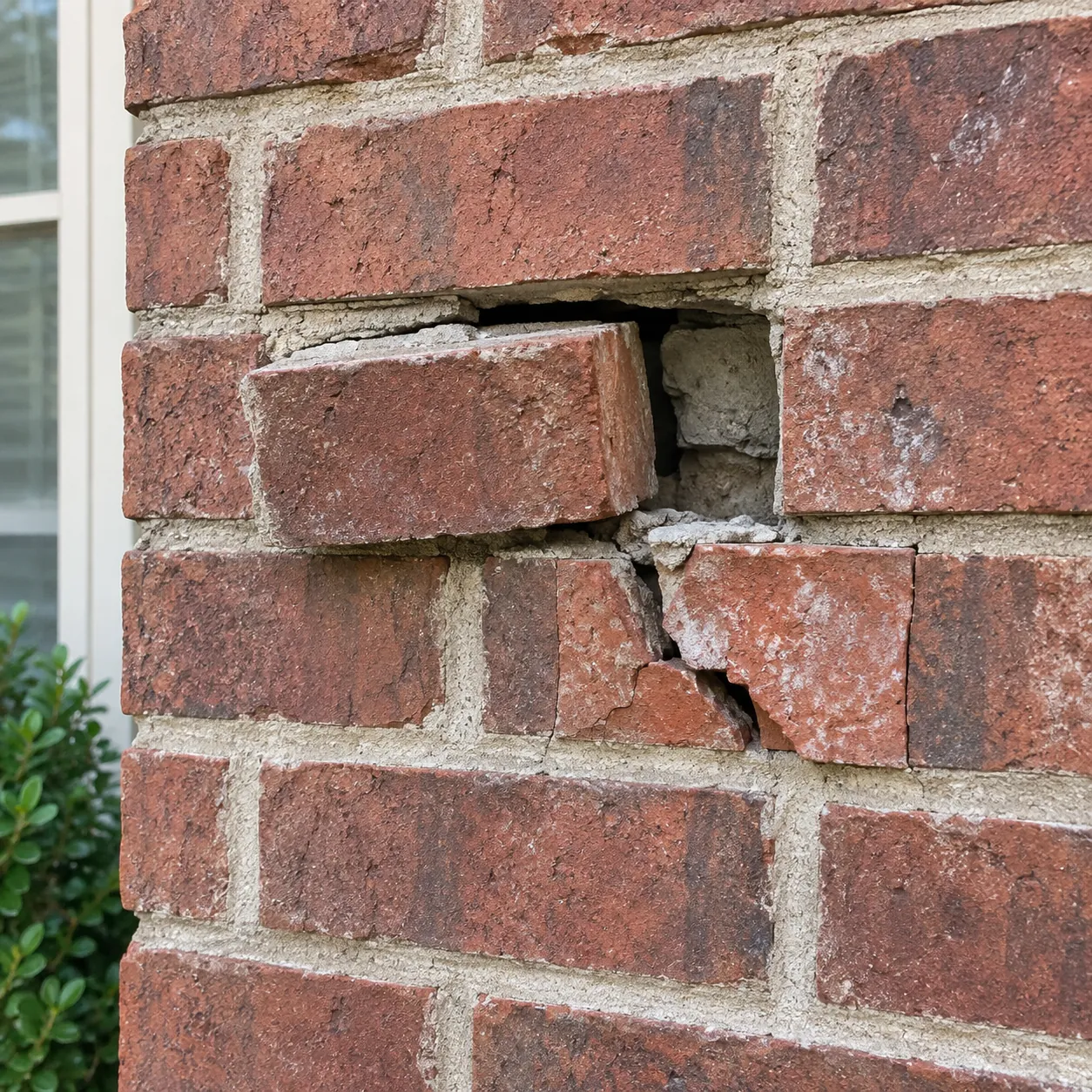
A loose or broken brick can be a localized repair when surrounding masonry is stable, but falling units, bowing or repeated looseness require a wider support and safety review.
Quick answer
A loose or broken brick can be a localized repair when surrounding masonry is stable, but falling units, bowing or repeated looseness require a wider support and safety review.
Loose units and impact damage need a stable repair boundary and a compatible replacement. Several causes can create a similar face pattern, which is why the first job is to preserve evidence and separate urgent safety questions from the eventual repair method.
Photographs can establish location, extent and visible movement. They cannot confirm concealed ties, corrosion, framing, flashing or soil behavior. When those details control the decision, an on-site review or a qualified specialist must come before cosmetic work.
Before → evaluate → repair
This is an educational decision path, not a claimed customer before-and-after project.
Compare movement, moisture, support, openings, previous repair and the sound boundary. Escalate structural, roofing or safety questions when they are outside masonry scope.
Focused brick removal, matching and rebuilding after the likely cause of damage is considered. The scope should explain preparation, compatible materials, exclusions and what would require a change.
Correct vs. incomplete
Adhesive or face mortar may hold a fragment temporarily without restoring full bedding, bond or support.
The responsible direction is to decide whether the condition is stable, what system is involved and which repair endpoint is supported by the evidence. A clean appearance is a result; it is not the diagnostic method.
See the related Brick Repair service ↗Possible causes
These are investigation paths, not a remote conclusion about the property.
Vehicles, ladders or landscape equipment can fracture a limited area.
Weathered or poorly bonded joints can stop restraining the unit.
Repeated saturation can weaken the unit or the joint around it.
Corners, caps and lintels can shift differently from the field of the wall.
Veneer movement may make several units feel loose together.
How to document it
Do not climb, pull on loose work or remove material merely to obtain a photo.
Do not pull on masonry above an entrance or occupied path.
Photograph several courses beyond the loose unit.
Note whether neighboring units move together or only one brick is affected.
Document impact, storm, leak or prior work when known.
Problem → question → next step
Request a condition review
Include the city or ZIP, when the condition was first noticed and whether it changed after rain, heat, a freeze, impact or nearby construction. That helps separate a masonry repair inquiry from a structural, roofing or safety question.
Urgency
Keep people and vehicles away from loose units, pronounced bulges, leaning freestanding walls and damaged masonry above doors or walks. Do not stabilize elevated work with improvised bracing. Rapid change, significant displacement, an uncertain load path or widespread distress can justify structural review before masonry repair.
Other specialists
A roofer may need to correct flashing; a chimney professional may need to inspect liner or draft; an engineer may need to evaluate support or movement; a municipality or historic-review office may control the approved scope. The masonry proposal should say where its responsibility begins and ends.
Keep exploring
Keep exploring
A lost brick face is a symptom often connected to moisture, salts, freeze events or incompatible repair.
Open page ↗ProblemBowing or Separating Brick VeneerOut-of-plane movement can involve ties, support, corrosion, moisture or structural movement.
Open page ↗ProblemLeaning or Damaged Brick Mailboxes & WallsFreestanding masonry can move from impact, roots, soil change, drainage or inadequate support.
Open page ↗Keep exploring
Keep exploring
Local service, related symptoms and official permit information for Grapevine, Texas.
Open page ↗Denton CountyLoose or Broken Bricks questions in The ColonyLocal service, related symptoms and official permit information for The Colony, Texas.
Open page ↗Denton / Dallas CountyLoose or Broken Bricks questions in LewisvilleLocal service, related symptoms and official permit information for Lewisville, Texas.
Open page ↗Denton / Tarrant CountyLoose or Broken Bricks questions in Flower MoundLocal service, related symptoms and official permit information for Flower Mound, Texas.
Open page ↗Denton CountyLoose or Broken Bricks questions in Little ElmLocal service, related symptoms and official permit information for Little Elm, Texas.
Open page ↗Common questions
Yes. Keep people away from loose masonry, especially above doors, walks and roofs, until it is secured or assessed.
Often, if adjacent masonry and support remain sound and the brick can be reused or matched.
Impact, deteriorated joints, water, movement or failed attachment can look similar at the face.
Do not disturb elevated or unstable masonry. Removal can release neighboring units or concealed debris.
Start with the project
Send a few details and useful photos for an initial review.