Prepare and rebuild to a verified boundary
Measure elevation and movement, confirm the supporting base, rebuild to consistent geometry with appropriate materials, and finish edges and drainage before opening the area to traffic.
North Texas masonry service
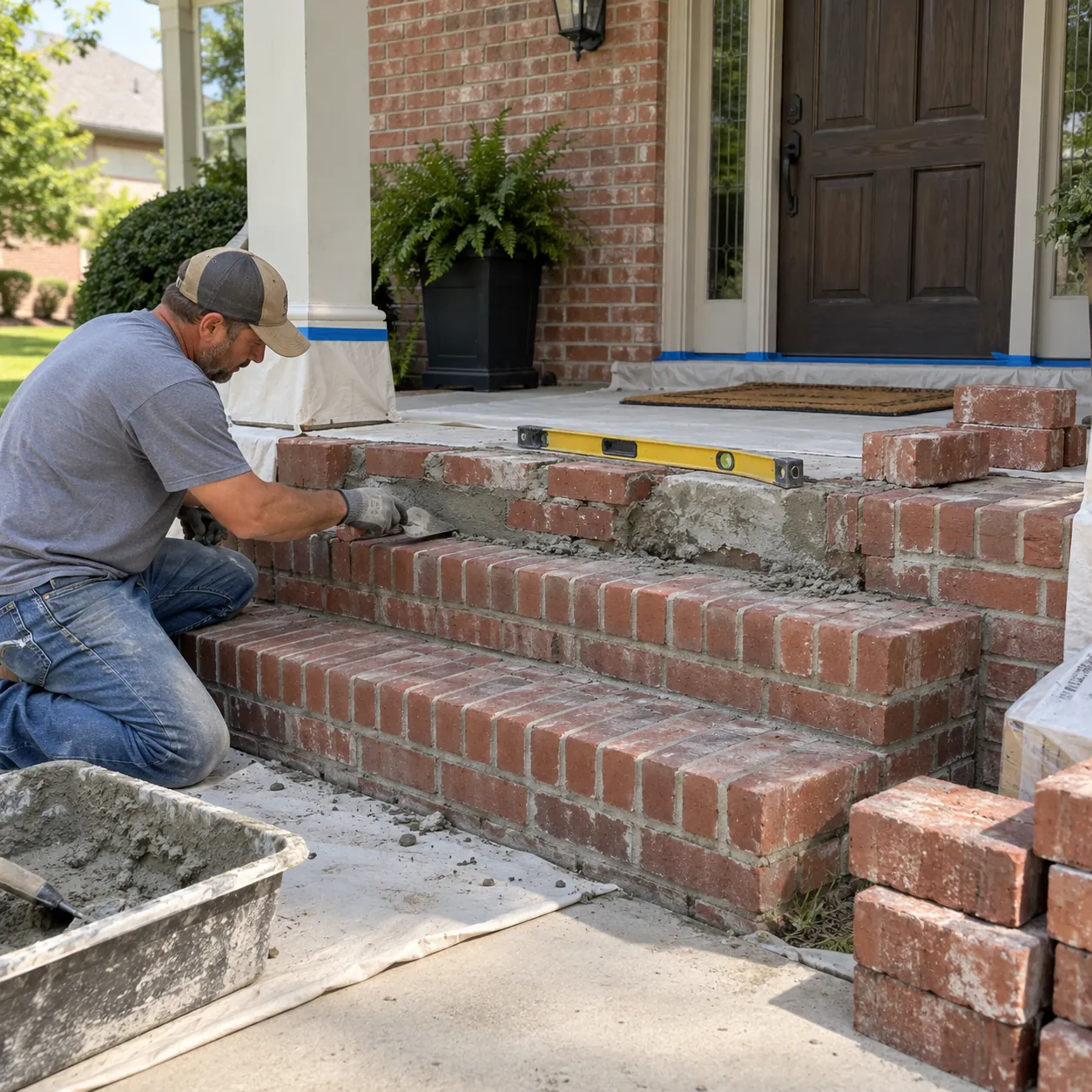
Brick steps, porches and walkways need stable support, safe geometry, drainage and slip-conscious finishes in addition to sound brick and mortar.
Direct answer
Brick steps, porches and walkways need stable support, safe geometry, drainage and slip-conscious finishes in addition to sound brick and mortar.
Walkable masonry experiences concentrated loads, edge impacts and water near grade. Settlement can create trip hazards; trapped water can loosen units; a threshold can be raised accidentally during resurfacing. The repair should preserve riser and tread consistency and direct water away from the building.
For North Texas properties, the same visible defect can come from different combinations of exposure, construction type, openings, prior work and building movement. A useful estimate therefore names the repair endpoint, the assumptions behind it and the conditions that would change the scope. It does not treat a city name, a photograph or a material label as a complete diagnosis.
Send one whole-wall view, one context view showing grade or openings, and one close detail. Include the city or ZIP and what changed.
How to photograph the condition ↗Correct vs. incomplete
A repair is complete only when preparation, material, sequence and the likely cause agree with one another.
Measure elevation and movement, confirm the supporting base, rebuild to consistent geometry with appropriate materials, and finish edges and drainage before opening the area to traffic.
Reset only the visibly loose paver or smear mortar over settled steps without correcting a washed-out base, trapped water or an unsafe height difference.
Is it the right fit?
Scope layer by layer
Small differences become noticeable and can create a trip condition.
Look for settlement, washout, roots and failed edges before resetting surface units.
Keep slope, joints and adjacent grade from directing runoff toward the door or wall.
Protect fresh mortar and define when normal use can resume.
How to read the work
Before work begins, the affected area should be distinguishable from neighboring sound material. During removal, the installer should be able to explain what confirms that the prepared edge is stable. New brick, stone or mortar should be selected for compatibility as well as appearance. Where water reaches the assembly, the scope should identify how it will drain or dry after the visible work is complete.
Afterward, review joint fullness, alignment, protection of adjacent surfaces and the transition from new work to old. Fresh masonry can change color as it cures, so the evaluation should follow the agreed sample and realistic weathering expectations rather than an instant promise of invisibility.
Request a project review
A photo-first review helps identify the relevant service page and the questions that belong in an on-site visit. It does not replace inspection where movement, hidden support, elevated work or active moisture controls the scope.
Typical process
Photograph the complete feature, the condition in context and a close detail with scale.
Review safety, access, water, movement, support and material compatibility before selecting the repair.
Write the repair boundary, preparation, materials, appearance expectations, exclusions and change conditions.
Protect adjacent work, perform the agreed sequence, manage curing and keep the site orderly.
Walk the finished boundary, cleanup, drainage details and any monitoring or maintenance recommendations.
Estimate factors
Photos can support an initial range, but final cost depends on measured quantity, access and what the prepared area reveals. A low unit price is not useful if the assumed boundary excludes the condition that made the repair necessary.
North Texas context
Dallas–Fort Worth climate normals include hot summers, recurring heavy-rain events and winter freezes. Regional maps also identify shrink–swell soils across parts of North Texas. Those conditions explain why movement and moisture deserve attention, but the cause at one address must be supported by the actual wall, grade, drainage, openings and history.
When the repair depends on structural capacity, parcel-level soil behavior, roofing, a fireplace system or municipal approval, the written scope should identify the qualified specialist or authority that must answer that question.
Keep exploring
Loose units and impact damage need a stable repair boundary and a compatible replacement.
Open page ↗Visible conditionCracks in Brick WallsCrack direction, width, displacement and change over time help determine the next question.
Open page ↗Visible conditionEfflorescence & Water IntrusionWhite deposits indicate moisture transported soluble salts through masonry; the water path matters.
Open page ↗Keep exploring
How failure area, support, displacement and matching affect the repair boundary.
Open page ↗MaterialsBrick & Mortar Matching GuideColor is only one part of a believable and compatible masonry match.
Open page ↗Cost & scopeBrick Repair Cost in DFWWhat changes masonry repair pricing, access, matching and scope.
Open page ↗Keep exploring
Local context, related symptoms and official permit information for Weatherford.
Open page ↗Collin CountyBrick Steps, Porches & Walkways questions in AllenLocal context, related symptoms and official permit information for Allen.
Open page ↗Collin / Dallas / Rockwall CountyBrick Steps, Porches & Walkways questions in WylieLocal context, related symptoms and official permit information for Wylie.
Open page ↗Rockwall CountyBrick Steps, Porches & Walkways questions in RockwallLocal context, related symptoms and official permit information for Rockwall.
Open page ↗Ellis CountyBrick Steps, Porches & Walkways questions in WaxahachieLocal context, related symptoms and official permit information for Waxahachie.
Open page ↗Common questions
Yes when the base and neighboring units remain stable. Repeated looseness suggests a broader support or water issue.
Settlement, thermal movement, rigid connections, trapped water and weak preparation can create similar cracks.
Texture, slope and exposure affect traction. Select units and finishes appropriate for walkable exterior use.
The written scope should give curing and protection guidance based on the materials and weather.
Start with the project
Send a few details and useful photos for an initial review.